

By Hannah Rowe
I just wanted to do a simple book review to encourage people to read “Delighting in the Trinity” by Michael Reeves.
As I stood in my friend and coworker Dylan’s office telling him why I thought people needed to read the book, sharing my thoughts on the importance of the doctrine, he listened to me as I passionately (with my notable hand motions) described the videos I had come across on social media regarding the Trinity. Remember that song, “In the beginning was the Word and the Word was with God. The Word was God” Yeah, such a banger. But it was written and performed by Indiana Bible College, an organization of Apostolic Pentecostals who reject the doctrine of the Trinity.
Well Dylan said no.
I was shocked and began to tell him even more passionately (with more hand motions this time) how people had no idea that these issues were discussed 2000 years ago and had been settled. And that’s why he said I had to do a microwave institute. So, instead of just talking about a really good and helpful book, I got to explain the hardest, yet most important doctrine of the Christian faith. No biggie. And I only had 4-10 minute segments. Easy enough.
I believe that if you don’t have a firm grasp on the Trinity you are on a slippery slope, easily able to be roped into bad theology. Without the Trinity we wouldn’t have the Incarnation. Without the Trinity we wouldn’t have eternal salvation. Without the Trinity we wouldn’t have the gospel. It really is that crucial.
I spent probably close to one hundred hours reading, writing, praying, talking to Jehovah’s witnesses and Latter Day Saints, rewriting, talking to church elders, rewriting again in order to bring you something valuable.
The Lynchpin of Christian Faith
There is one single thing that sets Christianity apart from every other worldview. Some worldviews have more than just one difference, of course, but the biggest thing that sets Christianity apart is the Trinity. There is no other worldview that recognizes it as legitimate. Latter Day Saints and Jehovah’s Witnesses for example, do not accept the doctrine (though I learned that LDS missionaries think they do). And this also means that as much as we might disagree with Roman Catholic, Eastern Orthodox, Lutheran, Presbyterian, or Reformed doctrine, they all have an orthodox (that is theologically sound) view of the Trinity and are therefore in the Body of Christ.
Reeves begins the introduction of his book, “Delighting in the Trinity” by saying, [I]t is only when you grasp what it really means for God to be a Trinity that you really sense the beauty, the over-flowing kindness, the heart-grabbing loveliness of God” (p.9). This is truly what sets the Christian God apart from the Jewish god, the Muslim god, the LDS god, the Jehovah’s Witness god, and the Oneness Pentecostal god. Reeves, and I, and many other great and smart theologians before us, declare that understanding the Trinity is the most important part of our faith. We can believe a man named Jesus existed, we can believe in a coming bodily resurrection, we can even believe in salvation by grace alone, but if we do not understand these things in light of a triune god, then we are not following the True God.
So what is the Trinity? Simply put, it’s the fact that the God of the Christian faith is 3 persons in one being: Father, Son and Spirit. He is just one God, not three gods. Three persons who all have the same divine attributes. The three-in-one who brought about creation, salvation, sanctification and one day full redemption. The entire plan of humanity has been carried out by this Triune God with God the Father sending God the Son to become flesh. After which God the Son died for the believer, and His death reconciles us back to Himself, God. The Father and the Son then send God the Holy Spirit to empower the Church and dwell within the believer.
Understanding this was so crucial because after Jesus’ ascension formations of heretical doctrines were immediately being circulated and many of them were centered around the Trinity. These issues became so prevalent that the Church came together as a council and created the Creeds. They all speak to the doctrine of the Trinity. There are three Creeds, each with a different amount of detail.
The Apostle’s Creed is the simplest and shortest, just making mention of the three persons: “I believe in God, the Father…in Jesus Christ, his only Son…in the Holy Spirit…” The Nicene Creed provides a bit more: “We believe in God, the Father…And in the Lord Jesus Christ, the only Son of God, begotten from the Father before all ages…begotten, not made; of the same essence of the Father…And we believe in the Holy Spirit…He proceeds from the Father and the Son, and with the Father and the Son is worshipped and glorified.” And finally the Athanasian Creed. It is the longest and most detailed. That’s because Athanasius was a student of Arius who taught that Jesus was created by God. Athanasius dedicated his life to preserving the doctrine of the Trinity so that today, 2000 years after Christ, we do not need to keep reinventing the wheel, although many people keep trying. (Just go read it yourself, it’s really long).
Of course, to know about the Trinity is not the same thing as knowing Him. If the truth doesn’t penetrate your heart and change you, then it’s of no real value. I want to make it very clear that knowing these things should not cause you to be puffed up. If your first thoughts include wanting to shove a Bible in a Latter Day Saint’s face, then you don’t have a grasp on it at all.
As I was studying for this I came into some work by St. Gregory Nazianzen. He and Augustine were among those who discussed the progressive revelation of God. That is, how God gradually revealed things about Himself over time as the Bible was written. This is true of the salvation plan, the Church, and the Trinity. St. Gregory said, “The Old Testament proclaimed the Father quite clearly, and the Son only dimly. The New Testament revealed the Son and allowed us to glimpse the divinity of the Spirit. Now the Spirit dwells among us and shows himself more clearly. When the divinity of the Father was not yet recognized it would not have been prudent to openly proclaim the Son; and when the divinity of the Son was not yet admitted it would not have been fair to impose…a new burden on men by talking about the Holy Spirit…It was necessary to go forward by way of successive clarifications, by increasing enlightening improvements and advances, in order to see the light of the Trinity shine out at last (Fifth Theological Discourse, No.26).
He explains that the Jews constantly had a problem with idolatry and worshipping false gods, so in his wisdom, God shielded them from turning their monotheism into polytheism. This means that it’s not always easy to see the Trinity in the Old Testament. It was especially hard for the Jews to see that the Messiah would be God Himself because it wasn’t clearly stated. But looking back with Spirit-filled eyes we can now see. For example, “Elohim” in Genesis 1:1 is used for “God”. We often state that it’s evidence of the Trinity because it’s plural. But while it’s true that today we can see the Trinity in that verse, the Jews would have read it as God’s greatness and power, not as triune. We have the Holy Spirit to “teach [us] all things” (John 14:26).
It wasn’t until we read of the baptism of Jesus that God ultimately revealed Himself as Trinity as all three persons were present. The Father speaking from heaven, the Son incarnate and the Holy Spirit descended as a dove (Matthew 3:16-17).
The official formation of the doctrine came around 325AD at the Nicene Council, but the apostles and early church teachers had been discussing the doctrine since the ascension. The Creeds however, give us language to help us better understand and share the doctrine with others. The Trinity is something difficult to understand. Augustine said that anyone who denies the Trinity is in danger of losing their salvation, but anyone who tries to understand the Trinity is in danger of losing their mind.
Many people may argue that the word “trinity” is not in the Bible, but it is inspired by all of the counsel of Scripture. Just like the word “omnipresence” is not in the Bible, theologians have taken the text, examined the implications, and created the terminology to explain the Christian God and the Christian faith. The word “trinity” is “tri – unity” meaning three-in-one. God equals the Godhead which equals the Trinity. They are all synonyms. So when I say “God” I don’t mean just God the Father, I mean God the Trinity. When I say the word “LORD” I mean God the Trinity. For example, in Deuteronomy 6:4 it says, “Hear ‘O Israel: The LORD our God, the LORD is one”. This verse could be saying something like “Hear Israel, the Trinity is our God, the Trinity is one”. We do not worship three gods, but one God.
There are two words that may help us to understand: being and person. Being is that which makes you what you are. Person is that which makes you who you are. As humans we are human beings, but we are all different people, or persons. Unlike God, all human persons are not united by the same essence, that is like a driving force, a common purpose and power. All of the persons of God are part of the same essence, they share in the same attributes and actions, but what makes them different persons is their different roles they play, and this makes them who they are.
The Father, the Son and the Holy Spirit all work together with the same power, drive, intention and will in order to do work in the world. And, this is very special, they do it all in love. Pastor, scholar and Bible teacher Tim Mackie says, “The universe is held together by an eternal community of love.” I agree, and think it’s quite a fitting descriptor.
Unity of Divine Operation
One of the most helpful ways to understand the Trinity is to recognize that the Father, the Son, and the Holy Spirit are not doing different kinds of work as if each had a separate responsibility. Instead, they are always working together in perfect unity. Scripture consistently shows that every work of God is carried out by all three persons. The Father, the Son, and the Spirit each fully participate in the same divine actions, but they do so in a way that reveals who they are.
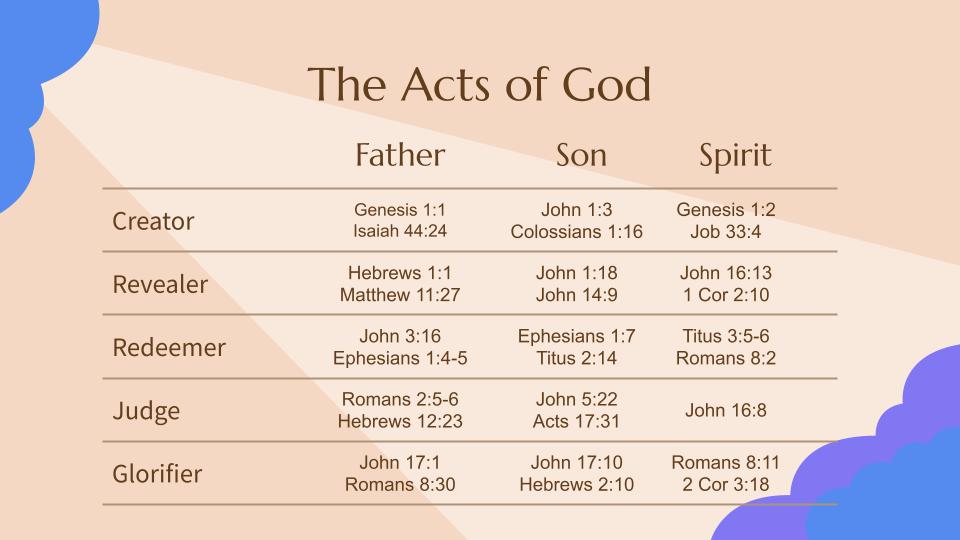
We can see this pattern clearly across several key themes in Scripture: creation, revelation, redemption, judgment, and glorification.
When we look at creation, the Bible leaves no doubt that God alone is the Creator of all things. In Genesis 1:1 and Isaiah 44:24, creation is attributed to the Father. At the same time, the New Testament teaches that all things were made through the Son, as seen in John 1:3 and Colossians 1:16. And from the very beginning, the Spirit is present and active, hovering over the waters in Genesis 1:2 and described as the giver of life in Job 33:4. This is not three separate acts of creation, but one unified act of the Triune God accomplishing the same work.
This same unity appears in how God reveals Himself. Hebrews 1:1 tells us that the Father has spoken throughout history, making Himself known to His people. Yet Jesus makes it clear in passages like John 1:18, and John 14:9 that He uniquely reveals the Father, even saying that to see Him is to see the Father. The Spirit, in turn, continues this work by guiding believers into truth and revealing the depths of God, as we see in John 16:13 and 1 Corinthians 2:10. Revelation, then, is not divided among the persons of the Trinity. It is one unified act in which the Father speaks, the Son perfectly reveals, and the Spirit opens our eyes to understand.
The unity of the Trinity becomes even more significant when we consider redemption. Salvation is not the work of one person acting alone, but the coordinated work of the Triune God. The Father is the one who sends and plans, as seen in John 3:16 and Ephesians 1:4–5. The Son accomplishes redemption through His life, death, and resurrection, securing forgiveness through His blood, as described in Ephesians 1:7 and Titus 2:14. The Spirit then applies that redemption to believers, bringing new life and freedom from sin, as we see in Titus 3:5–6 and Romans 8:2. This is not a divided effort, but one unified act of salvation in which each person of the Trinity is fully involved.
Scripture also shows this same pattern in judgment. The Father is described as the righteous judge in passages like Romans 2:5–6 and Hebrews 12:23. At the same time, judgment is entrusted to the Son, as Jesus Himself says in John 5:22 and as Paul affirms in Acts 17:31. The Spirit, meanwhile, works in the world to convict people of sin and righteousness and judgment, according to John 16:8. Once again, we do not see separate or competing roles, but a unified work of justice carried out by the one true God through the distinct persons of the Trinity.
Finally, we see this unity in glorification, which is the ultimate goal of salvation. The Father is the one who brings His people to glory, as seen in John 17:1 and Romans 8:30. The Son shares His glory with those who belong to Him and leads many sons to glory, as described in John 17:10 and Hebrews 2:10. The Spirit is the one who transforms believers, raising them to new life and conforming them to the image of Christ, as we see in Romans 8:11 and 2 Corinthians 3:18. Even here, at the end of all things, the work is not divided. The same God who begins the work is the one who brings it to completion, acting as Father, Son, and Spirit.
When we step back and take all of this together, a clear pattern emerges. The Father, the Son, and the Holy Spirit are never acting independently of one another. Everything God does is done in perfect unity, with each person fully sharing in the same divine work. And yet, within that unity, there is a beautiful distinction: the Father as the source, the Son as the mediator, and the Spirit as the one who applies and brings to completion.
From creation to redemption to final glory, God is always working as Father, Son, and Holy Spirit—one God, perfectly united in power, purpose, and love.
An Atoning God
As the Church celebrates the observance of Atonement Friday and the celebration of Resurrection Sunday I find that it is critical to reflect on the necessity of the Trinity for our faith.
The book of Hebrews is the current topic of study in our young adults group and it doesn’t leave us any room to treat the atonement as optional or symbolic. It presses in on a simple, unavoidable truth: sin separates, and separation demands sacrifice. Over and over again, Hebrews reminds us that “without the shedding of blood there is no forgiveness of sins” (Hebrews 9:22). This is a reality.
Under the old covenant, sacrifices were offered continually. Priests stood daily, making offerings that could never fully cleanse the conscience. The repetition itself was the point; if it had worked, it would have stopped. But it didn’t. The system was never meant to be the solution; it was meant to point forward.
That’s where Christ enters.
Hebrews tells us that Jesus is not just another priest—He is the better priest (Hebrews 4:14). He is the final sacrifice. Unlike the priests who offered external sacrifices, Christ offered Himself. And unlike the blood of bulls and goats, His blood actually accomplishes what it signifies. He covers sin by taking it away completely, and he satisfies wrath by bearing it in full.
But here’s where the Trinity becomes essential: Christ must be fully man to represent us and fully God to provide a sacrifice of infinite worth. Every human stands under the sentence of death, so none can pay the debt for another. Only one who does not owe death could defeat it; God Himself. And in doing so, Christ doesn’t simply die in our place, He “pulls us through death” with Him, as Tim Mackie says. Only God can save, and yet only man could die in man’s place. In Jesus, we have both.
Hebrews makes it clear: if Christ is not who He claimed to be, then the entire system collapses. There is no forgiveness, no mediation, no access to God. But because He is the eternal Son, His once-for-all sacrifice is sufficient for all who believe.
This theological framework becomes painfully tangible when we turn to Gospel of Mark, chapter 15. Here, the atonement is enacted.
Jesus is mocked, beaten, and ultimately crucified. The King of Kings is treated like a criminal. The One who spoke creation into existence (John 1:1-3) hangs in weakness. And yet, this is the plan of God unfolding.
When Jesus cries out, “My God, my God, why have you forsaken me?” (Mark 15:34) We are witnessing something profound. The Son is bearing the weight of sin. The judgment that Hebrews speaks about is being poured out in real time. This is the cup of wrath, and Christ drinks it in full. And then, He dies.
At that moment, Mark tells us that the veil of the temple was torn in two (Mark 15:38). That detail matters. The veil separated the Holy of Holies, the place of God’s presence, from the people. Only the high priest could enter, and only once a year, and only with blood, but now the veil is torn. Not from bottom to top, as if man reached up to God, but from top to bottom, as God Himself makes the way. Access has been granted. The sacrifice has been accepted.
But the story does not end in chapter 15. If it did, we would still be left wondering: Was it enough? That’s why Gospel of Mark chapter 16 is essential.
The resurrection is divine confirmation. It is the Father’s declaration that the Son’s sacrifice was sufficient. Death could not hold Him, because the debt had been paid. Sin had been dealt with. Justice had been satisfied. If the cross is where atonement is accomplished, then the resurrection is where it is validated. Without the resurrection, the cross could be seen as defeat. With it, we see it for what it truly is: victory.
But the resurrection is more than confirmation. It is also our hope! Believers are united with Christ not only in His death but in His resurrection. Paul teaches that those who are joined to Christ in His death are raised with Him (Romans 6:5), so that His victory over sin and death becomes ours as well. In this sense, the resurrection is both the inauguration of the new creation and the guarantee that we, too, will share in Christ’s life, walking in newness now and looking forward to the fullness of the resurrection to come. Christ doesn’t just rise alone; He pulls us through death with Him, giving us a living hope grounded in His triumph.
In the end, this is why I wanted to share all of this. Not just the book, not just theology, not just history, but the living reality of God Himself. The Trinity is not a dry doctrine to memorize; it is the very framework of our salvation, and it is a truth to be experienced. The Father, the Son, and the Holy Spirit work together in perfect love and unity to bring us from death to life, from separation to communion, from sin to forgiveness. The cross shows the cost of sin. The resurrection shows the power of God. And through the Spirit, that victory becomes ours.
WATCH
Easter message (Mark 16) – The Gospel of the Empty Tomb