
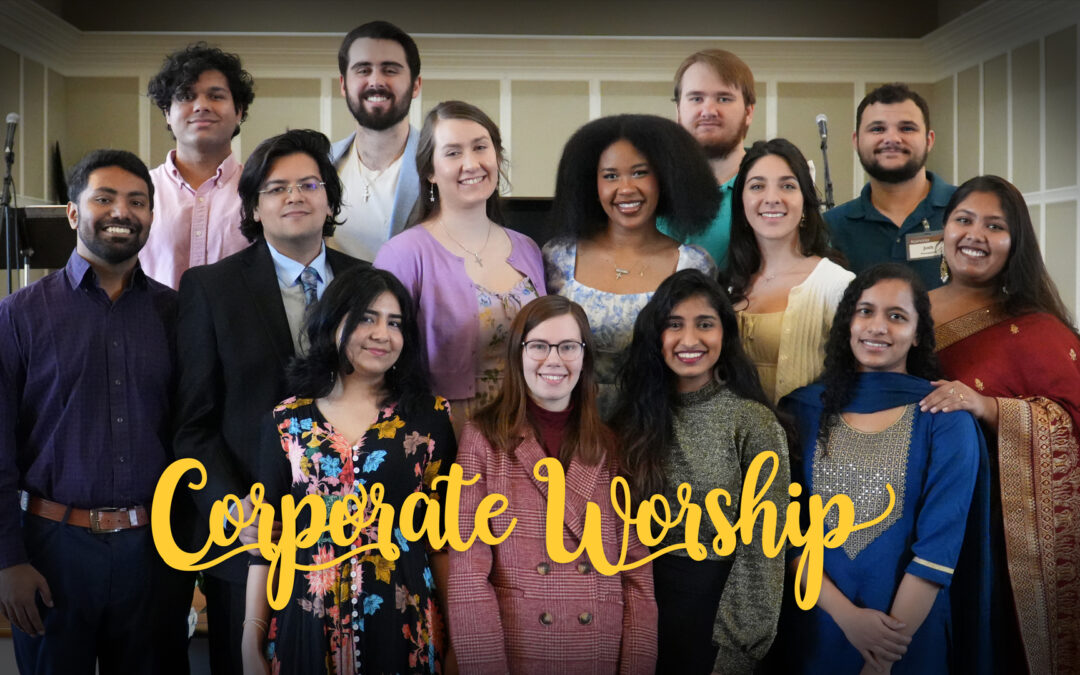
The Church is a Gathering
By Dylan Ocorr
We have no shortage of ideas about “church” that proliferate through Christian circles. Among the top pithy one-liners is the phrase “the church is not a building, it’s the people.” It’s so common that we almost are ready to quote chapter and verse when we hear someone say it. But how helpful is this statement today? Or, rather, was it ever even true?
Short answer – yeah, kinda. If we are talking to a culture that believes that Christianity is all about being listed on the directory of a local church, memorizing John 3:16, and taking a public bath (whether as an infant or an adult), then this statement is certainly helpful! Such a culture views church as simply another part of social life. But, if we want to speak about the “church” with the same force and vitality as Scripture, then the church is much more than a building. It is much more than a mere faction of social engagement. There ought not be our “church life” and our “family life” and our “work life” and so on. In so far as that is the prevailing idea around church, then we shall join in with the chorus and sing “The church is not a building, it’s the people.”
Such a thought emphasizes the personal reality of the Christian faith. It is not about buildings and liturgies and board meetings and committees as much as it is about personal “repentance towards God and faith in our Lord Jesus Christ.” (Acts 20:21). And to that we say “Amen!” But, if we allow that statement to go from correcting our ideas about church to governing our ideas about church, then we will end up with a “church” whose only necessary assembly is in our own hearts – a far cry from the picture of church that the new testament paints.
This weekend, I had a demonic encounter. It was terrifying and exhausting. I wouldn’t choose to experience it again, but I learned a lot. Strangely, I also have peace. That said, I don’t want to dwell on the details.
I’ve slept, I’ve rested, but I’m still deeply tired. Spiritual battles are draining.
John 1:5 says, “The light shines in the darkness, and the darkness has not overcome it.”
I was so eager for church on Sunday. I took communion for the first time in a while. I served in the nursery, hugged friends, worshiped, and heard powerful teaching about hope, restoration, and discernment. I felt safe and known.
Then darkness walked into the building and came straight for me. I ran, and was literally caught by the arms of church leadership. Just like 1 Peter 5 describes, they shepherded and protected me with tenderness and strength.
There is something spreading in today’s church: detachment from the local body. Many say they believe in the “global church” but don’t engage with a local one. Some attend occasionally but stay disconnected. But without my church, I would not have survived this weekend. The enemy thought I was alone. He was wrong.
There is not a single perfect church. Because it is full of people. And people are not and never will be perfect. Church is not supposed to be a building. But buildings are where the people go. Buildings cannot pray for you. They cannot lay hands on you. Cannot hug you and kiss you. Cannot anoint you with oil. Cannot laugh with you. But people can. And churches have people.
So please, find a church. If you’re facing pain, fear, sadness, or loss, go. It’s a hospital for the broken. Let people see your burdens so they can carry them with you to Jesus.
Your local church needs you too. Someone may walk through the doors this week needing you. Your presence, your prayers, your protection.
Koinonia, thank you. Thank you for protecting me, praying for me, and being the hands and feet of Jesus. You are deeply needed.
“If one member suffers, all suffer. If one is honored, all rejoice.” —1 Corinthians 12:26
-Note from Hannah
So, let’s take a closer look at what the New Testament says about church.
The word for “church” in Greek is the word “Ekklēsia”. That word had a meaning before it was employed by Jesus. In ancient Rome, an “Ekklēsia” was a gathering of Roman citizens (usually in some conquered territory) that were called out of their homes into the public square. There they could make decisions on behalf of Rome in whatever province they found themselves. So, thinking of this called-out body of Roman citizens meeting in public, Jesus turns his thoughts to his followers and says, “I will build my [own] Ekklēsia.” (Matthew 16:18). It’s as if, in order to communicate how the body of Christians would function, Jesus looked at the Ekklēsia system in the Roman government and said “Let’s do that for ourselves.”
The Church (Ekklēsia) is not a building. But it is also not simply “the people” either. It is the public gathering of the people of God. It is truly an assembly. As Matt Merker says, in his book entitled “Corporate Worship” – “A local church is an assembly. If it never meets, it is no church at all.”
This idea is carried through the New Testament – we see it exemplified in Acts and echoed through the epistles. One of the most prominent places this idea finds resonance is 1 Corinthians 11-14. Paul uses this word several times to describe a distinct event that took place (1 Corinthians 14:19), as opposed to simply the existence of a group identity. And he also assumed that these meetings were taking place regularly (1 Corinthians 11:18).
The church is not simply “the Christians”. The church is “the gathering of the Christians”.
Church is for Christians
In 1993, another idea was popularized that would reshape our thinking around church. Ed Dobson, a pastor at the time, wrote a book entitled “Starting a Seeker Sensitive Service”. In it, he advocated for churches to start a Saturday service that was geared toward the non-Christian. He suggested that this service should contain six characteristics: informal, contemporary (non traditional), no pressure for involvement or commitment, relevant to these people’s needs, casual, and visually appealing. It was Ed Dobson’s way of reaching the non-Christian world that had grown disenchanted with Christianity.
So, churches started to employ this strategy. And they saw more and more people come to church. Win! Right? The only problem was – as church leaders saw how successful these principles were – instead of starting a Saturday evangelistic service as Dobson suggested, they remodeled their Sunday service. So, over the years, the six characteristics Dobson wrote about increasingly typified Sunday services. This is what some Christians have called “the seeker sensitive movement”, fueled by the belief that the best way to reach the world with the gospel is by making church service more relatable to the non-Christian.
There is one huge pimple on the face of this movement: Church was never meant for the non-Christian. Church is for the Christian. In fact, as we saw above, a “church” is a gathering of Christian people. Without the Christians gathering, there is no church. You may be able to fill the Buffalo Bills stadium with people, but until the players start to play, it’s not a football game. When we structure church around the unbeliever, we abandon the primary purpose of church and trick ourselves into thinking that we are getting people to attend church. Instead, whatever meeting people are attending, it is no longer the assembling of the saints for worship; it is the assembling of the non-Christians for evangelism.
1 Corinthians 14:23-25 – “If, therefore, the whole church comes together and all speak in tongues, and outsiders or unbelievers enter, will they not say that you are out of your minds? 24 But if all prophesy, and an unbeliever or outsider enters, he is convicted by all, he is called to account by all, 25 the secrets of his heart are disclosed, and so, falling on his face, he will worship God and declare that God is really among you.”
Let’s draw out a few principles from here:
– Church should involve the whole body of Christians
– Church should be open to the non-Christian
– We should expect non-Christians to be at our church services
– The way a non-Christian engages with church is similar to “overhearing” or “eavesdropping” on an interaction
– The point of keeping our church services open to unbelievers, is that we want them to acknowledge that “God is really among” us.
We can sum it up like this: Church is directed towards the believing community, while expecting unbelievers to be present and overhearing.
Before I started my full-time job, I spent most of my days surrounded by believers. The only time I wasn’t was during my part-time job, which was a very small part of my day. But everything changed when I became a full-time receptionist.
All of my coworkers were unbelievers, except for one. From the first day, I saw God opening doors for me to minister to them, and I was so thankful because I really wanted to share the gospel. Still, I began to miss the fellowship I had before. My schedule had completely flipped, and now I was spending most of my time with unbelievers. Because of work, I had to step back from some church and ministry activities, and I started to feel isolated.
One of my supervisors is an atheist who loves to debate Christianity and the Bible. I’ve had several conversations with him, some thoughtful, others exhausting. He always wants to be right, but he keeps coming back with more questions. I’ve been praying for him and that the truth will begin to take root.
In March, the weight of it all hit me. I was drained from a week of hard conversations, and I deeply missed being around fellow believers. Then on a Thursday, I got a call from my roommate that our apartment had flooded. A maintenance worker accidentally triggered the sprinkler system. The three of us rushed home, stood in our soaked apartment, and just started laughing. It wasn’t great, but we knew God would work it out. We turned on worship music and started cleaning.
Our apartment manager told us we would need to move to an identical unit upstairs. As we started packing, church friends began texting us, eager to help. I had to tell them to wait until the water was gone! But as soon as it was, my best friend showed up with her toddlers in tow, and more friends followed. They gave up their whole day to help us move, even though a moving crew was scheduled for the next day. We had dinner together and spent the whole day fellowshipping. It was such a gift.
That day, God reminded me that I’m not alone. Even though I don’t get to be with my church family as often as before, I’m still part of the best family, the family of God.
As 1 John 1:3 says, “Indeed our fellowship is with the Father and with His Son Jesus Christ.” The purpose of salvation isn’t just heaven or becoming a better person. It’s fellowship. With God. With one another. And I get to experience that in different ways, sometimes in personal prayer, sometimes in deep conversations, and sometimes, like this day, in the simple joy of serving and being served. That’s where I see His love most clearly.
– Note from Abi
At Church We Sing
Some elements of church are so powerful that even atheists want to get involved.
Have you ever heard of an atheist church? Seems like an oxymoron, right? But it exists! It’s called the “Sunday Assembly”. All over Europe (and now in America and several other countries), atheists gather in public meeting halls to participate in the “Sunday Assembly”. What goes on in these ‘churches’? Well, just take your average evangelical, non-denominational service, and change the content. There is singing, a message, and fellowship after. Yes, that’s right, they sing! Songs like “We Are the World” or “Imagine” resonate through the meeting hall as the attendees raise a chorus of unbelief. Much can be dissected from these meetings, but we will suffice to say one thing: namely, that these atheists recognized the unifying power that singing together brought to the Christian church, and they co-opted it for themselves.
But why do we sing at church in the first place? The Sunday school answer is – because the Bible commands us (Psalm 100:1-2, 105:2, etc.). But the Bible also tells us why. Certain things take place when we sing together:
– We are filled with the Holy Spirit – Ephesians 5:18-19, Colossians 3:16
– We encourage one another – Colossians 3:16
– We are united in Christ – Colossians 3:14, Ephesians 4:3
– We experience God’s presence in a way that is otherwise unattainable on our own – Acts 16, 2 Ch 5:13
Singing together is a divinely appointed practice through which we receive Heavenly blessings: filling with power, encouragement, unity, God’s very presence. The emphasis here is on singing together. When the Christians assemble for church, they sing. The assembly sings. To pick up our Buffalo Bills analogy… the fans scream. Screaming is not the reason why they came to the stadium, and they certainly did not come to the stadium to hear the best screamers scream. They came to watch the game and to scream together. Could they have watched the game from home? Yes. But then they would not have been joining in the chorus of all the loud-screamed.
Many churches today function as if the goal of singing in church is to hear the best screamers scream. The lighting changes to focus on the people on stage, the sound system cranks, and the 2-3 professional singers on microphones belt out their “hallelujahs”. Now, there is nothing inherently wrong with any of these production decisions. However, it sends us a message loud and clear – that we have come to hear the people on stage sing, rather than join in. When the lighting keeps us from seeing the people around us, and the sound system keeps us from hearing the people around us, then we have missed the point. Church is the gathering of the Christians to worship together. We receive the blessings through song that the New Testament speaks of when we all join in and sing. When the assembly raises a chorus of praise, and we find ourselves heartily joining in, we will also find ourselves being filled with the Holy Spirit, encouraged in our faith, united in Christ, and experiencing the glory of God’s presence.